in-between: a story of home, belonging, and the Asian Diaspora

September 23–28, 2025, MIDORI.so Bakuroyokoyama
in-between explores the immigrant experience through the lens of the Asian diaspora. Drawing on personal narratives, macroeconomic data, and interactive technologies, the exhibition navigates the tensions between displacement and belonging, memory and movement, personal identity and geopolitical history.
At the center of the exhibition is a guiding question: In an age defined by global movement and digital interconnectivity, what is “home”?
Blending data visualization, physical installation, and generative storytelling, in-between creates an immersive space for audiences to reflect on how place, ancestry, and identity are continually reshaped.
“deportation” (2025)
In March 2025, the U.S. deported 238 Venezuelans—most with no criminal charges or records—to an El Salvadorian prison without due process. Soon after, the U.S. State Department revoked thousands of international student visas. These reports come at a time of heightened nationalistic and anti-immigration sentiments around the world.


In this piece, a machine drips water onto delicate washi paper, each printed with my immigration history. Using Google Trends, the cadence of water drips mirror search volume for the word “deportation” from 2016 to 2025 worldwide. Over time, the delicate paper blurs and wears away with the persistent water drops.

home:1–8 (2025)
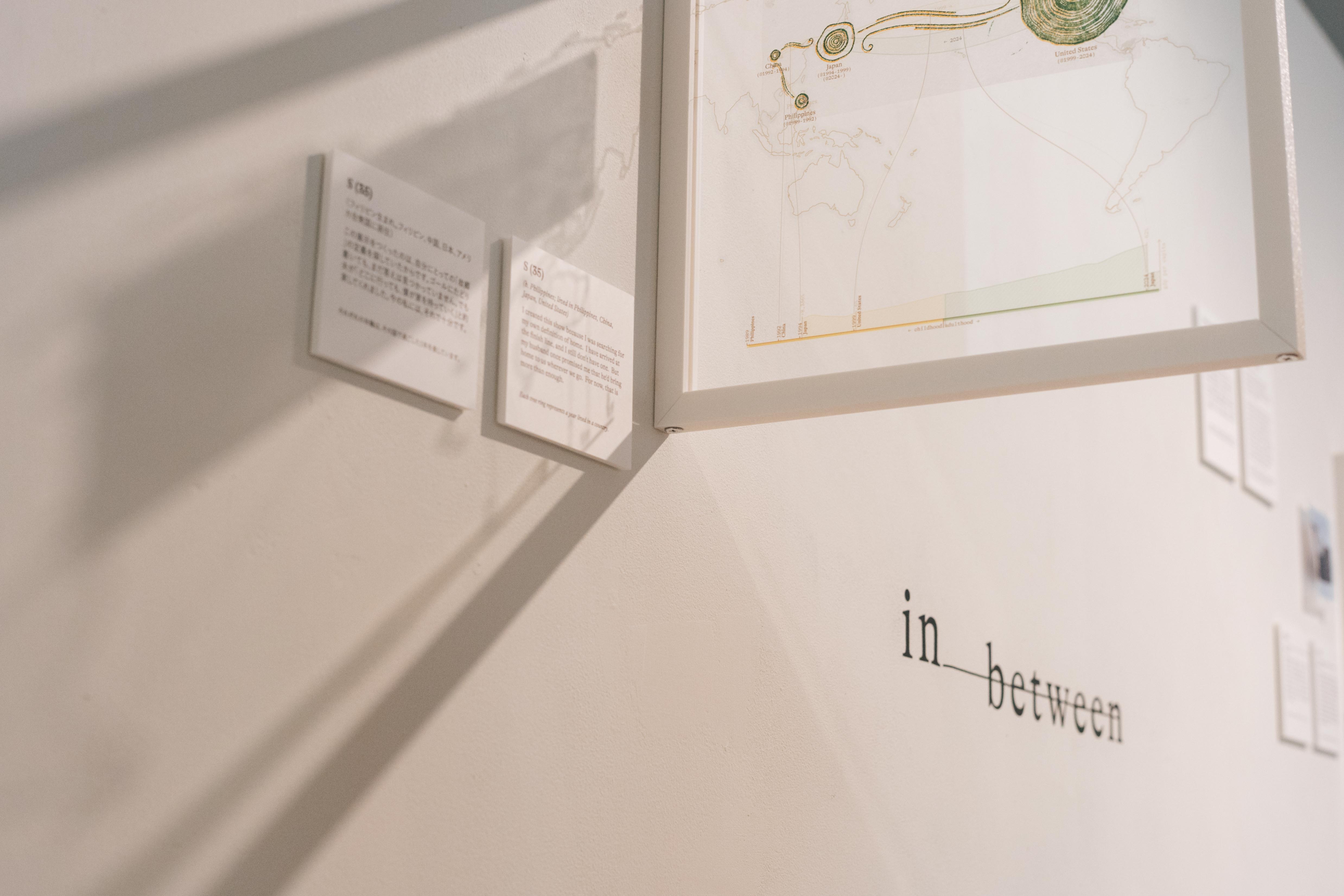
In search of my own definition of home, I interviewed seven others with similar backgrounds to me: Asian diaspora who grew up in a Western country and chose to move to Japan in their adulthood.
Their journeys are visualized as tree rings, each ring representing a year they have lived in a country. Each international move is captured as wind, a visual metaphor for seeds drifting and re-rooting elsewhere. Their journeys are contextualized by a timeline of the annual GDP (gross domestic product) per capita of the country they were living in at the time—reminder of the macroeconomic factors often at play in each move. The visualizations are paired with an excerpt from their interviews, as well as a photo that reminds them of home.


home:collective
Visitors are invited to enter the years and countries they’ve lived in, and to share what “home” means to them. In return, the system creates a visualization of their journeys, and connects them with another visitor whose idea of home is similar to theirs—but whose background may be completely different.
Their answers are stored locally; nothing leaves the exhibition.

